Fundamental Theorem of Calculus: Part 1, Part 2 & Visual Meaning
The theorem does two jobs that look different until you see the same accumulation function underneath them. Move the upper bound first: accumulated area becomes F(x), and its slope returns the original height f(x). Then reverse the direction: any antiderivative lets you evaluate exact accumulated change with endpoint values.
Move the idea
Try it: move the upper bound
Change one parameter and watch what changes with it.
Integration builds accumulated change; differentiation reads its instantaneous rate. The Fundamental Theorem says these operations reconnect, so area, slope and antiderivatives are not separate tricks.
Accumulation creates a function
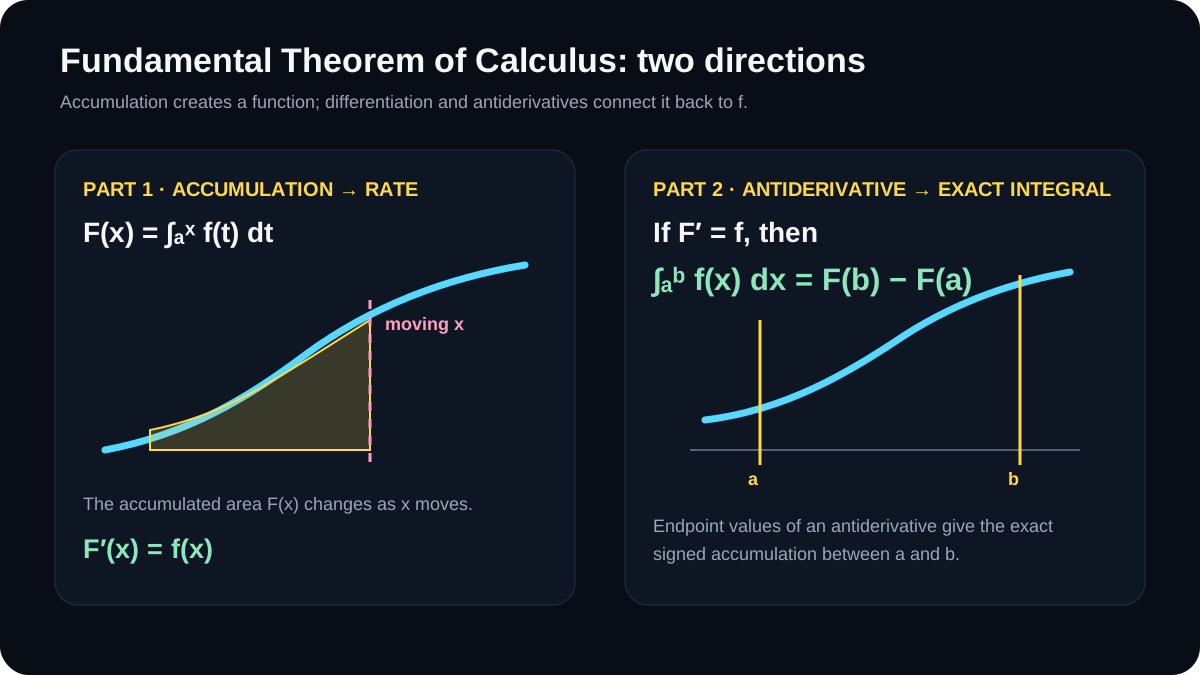
Let F(x)=∫ₐˣ f(t)dt. Moving x changes the signed accumulation, so F is a genuine function whose input is the moving endpoint.
Part 1 recovers the original rate
When f is continuous, F′(x)=f(x). A tiny move in the endpoint adds a thin strip whose area is approximately f(x)Δx, so accumulated area changes at rate f(x).
Part 2 evaluates accumulated change
If F is any antiderivative of f, then ∫ₐᵇ f(x)dx=F(b)−F(a). The endpoint subtraction measures the exact change in an accumulation function across the interval.
Make the idea reusable.
Why the two parts belong together
Part 1 starts with an integral and differentiates the accumulation function. Part 2 starts with an antiderivative and uses it to evaluate an integral. Both statements express that differentiation and integration undo one another under the theorem's conditions.
Conditions matter
A common classroom version assumes f is continuous on [a,b]. This is enough for the accumulation function to behave cleanly and for the standard Fundamental Theorem statements used here.
Net change, not always geometric area
A definite integral counts signed accumulation. Regions below the x-axis contribute negatively, so F(b)−F(a) represents net change unless the problem specifically asks for total geometric area.
What does the Fundamental Theorem of Calculus say?
The Fundamental Theorem of Calculus connects derivatives and definite integrals. Part 1 says that if F(x)=∫ₐˣ f(t)dt and f is continuous, then F′(x)=f(x). Part 2 says that if F is an antiderivative of f, then ∫ₐᵇ f(x)dx=F(b)−F(a). Together, the two parts explain why accumulated change can be read through derivatives and evaluated through antiderivatives.
See the two directions of the theorem
How to use the Fundamental Theorem of Calculus
- 01Decide which direction you need
If you are differentiating an accumulation function with a moving upper bound, use Part 1. If you are evaluating a definite integral, find an antiderivative and use Part 2.
- 02Check the setup
For the standard theorem, make sure the integrand is continuous on the interval you are using. Keep the dummy integration variable separate from the moving endpoint when writing an accumulation function.
- 03Apply the matching statement
For G(x)=∫ₐˣ f(t)dt, write G′(x)=f(x). For ∫ₐᵇ f(x)dx, choose F with F′=f and compute F(b)−F(a).
- 04Interpret the sign and units
A definite integral is net accumulated change. A negative answer can be correct when negative contributions outweigh positive ones.
Worked examples of both parts
Evaluate a simple definite integral
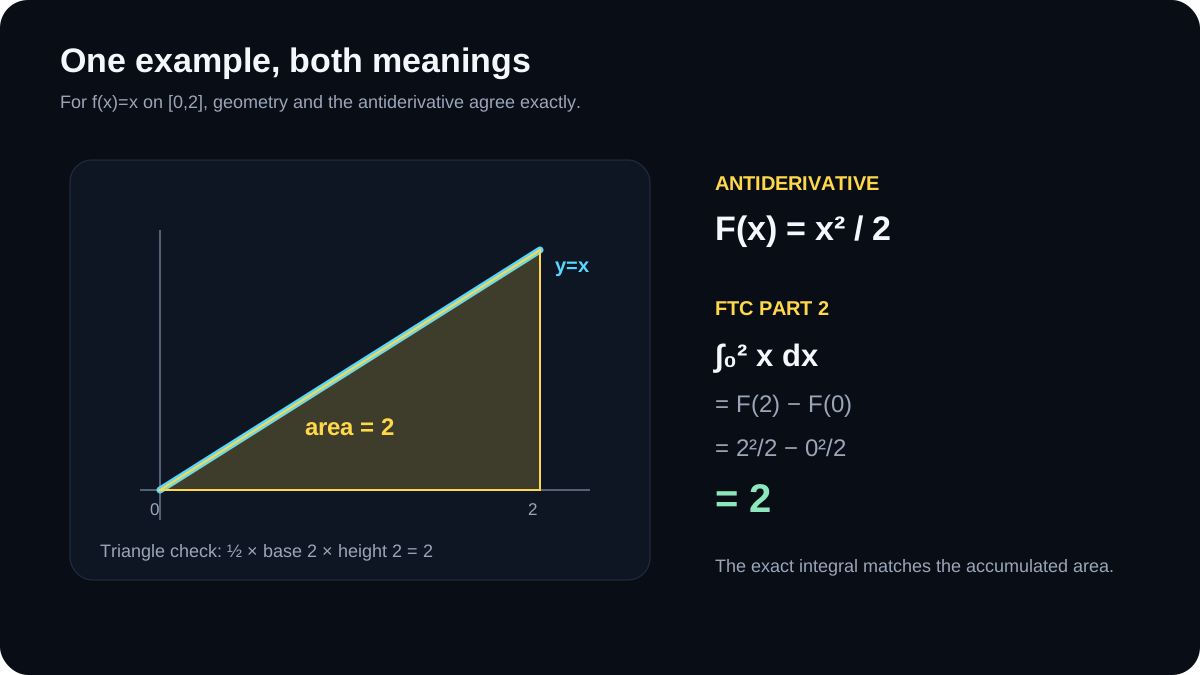
The value is 2. The antiderivative is x²/2, so F(2)−F(0)=2−0=2.
Evaluate a trigonometric integral
The value is 2. Using F(x)=−cos(x), the endpoint difference is 1−(−1)=2.
Differentiate an accumulation function
G′(x)=x²+1. The moving upper bound means Part 1 returns the integrand evaluated at x.
Part 1 vs Part 2
| Type | What it describes | Typical example |
|---|---|---|
| Part 1 | Differentiate an integral whose upper bound moves. | d/dx ∫ₐˣ f(t)dt = f(x) |
| Part 2 | Evaluate a definite integral using any antiderivative F with F′=f. | ∫ₐᵇ f(x)dx = F(b)−F(a) |
| Accumulation lesson | Build intuition for why the area total itself can be a function. | Move b and watch F(b) change before using the theorem formally. |
Fundamental Theorem of Calculus FAQ
Are Part 1 and Part 2 different theorems?
They are commonly presented as two parts of the same theorem because both express the inverse relationship between differentiation and integration from complementary directions.
Why do we subtract F(a) from F(b)?
An antiderivative value acts like an accumulated-total reading. F(b)−F(a) measures the net change in that accumulated quantity between the two endpoints.
Does the definite integral always equal geometric area?
No. It equals signed accumulation. To find total geometric area when the function crosses the x-axis, split the interval and account for absolute area as needed.
What is the difference between the accumulation function and the FTC page?
The accumulation lesson focuses on one moving-area mechanism. This page formalizes both FTC directions and adds exact antiderivative evaluation, so the two pages serve different primary intents rather than duplicating each other.