Removable Discontinuity: Definition, Graph Hole & Limit
Factor the numerator and the expression becomes x + 1 everywhere it is defined. The graph is therefore the line y = x + 1 with one missing point at (1, 2).
Move the idea
Try it: move x toward 1
Change one parameter and watch what changes with it.
At x=1, f(1) is undefined. But from either side, the gap between f(x) and 2 shrinks toward zero. That shrinking gap — not the missing point — is why the limit is 2.
Nearby behavior
From 0.9, 0.99 and 0.999 the outputs are 1.9, 1.99 and 1.999. From the right, 1.1, 1.01 and 1.001 give 2.1, 2.01 and 2.001. Both sides close in on 2.
What cancellation means
Cancelling x−1 says the two expressions agree where both are defined. It does not put the missing point back into the original function.
Common mistake
Direct substitution gives 0/0, but 0/0 is an indeterminate form, not a verdict that the limit fails.
Make the idea reusable.
Worked example: a hole at x=2
For g(x)=(x²−4)/(x−2), factor x²−4=(x−2)(x+2). For x≠2 the function equals x+2, so values near 2 approach 4 even though the original expression is undefined at 2.
Removable vs other discontinuities
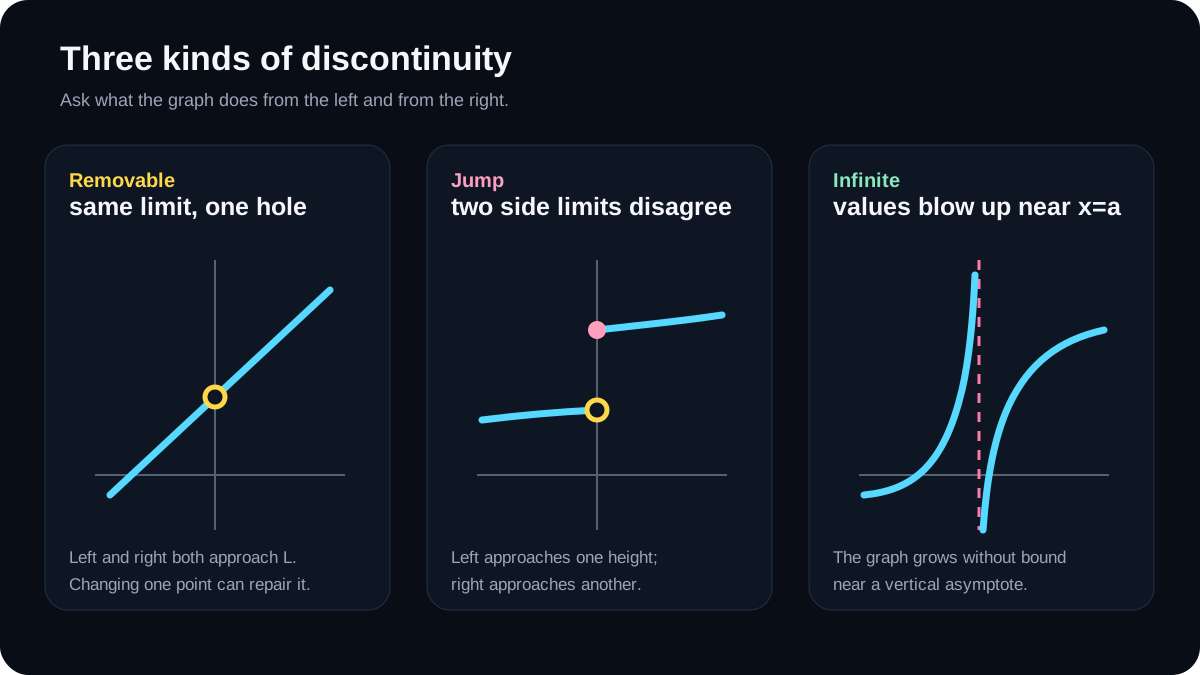
A removable discontinuity can be repaired by defining one missing function value. A jump has different left and right limits, while an infinite discontinuity grows without bound; changing one point cannot repair either one.
A reliable test-day sequence
First try substitution. If it gives 0/0, simplify the expression for nearby x-values, then check the left and right behavior. Only after finding the limit should you separately ask whether f(a) exists.
What is a removable discontinuity?
A removable discontinuity occurs at x=a when the two-sided limit exists and is finite, but the function is either undefined at a or has the wrong value there. On a graph it appears as a hole in an otherwise continuous curve. Defining f(a) to equal the limiting value repairs the discontinuity without changing nearby behavior.
See why a hole is different from a jump or blow-up
How to identify a removable discontinuity
- 01Find the suspicious x-value
Look for a denominator that becomes zero, a missing point on a graph, or a piecewise definition whose value may not match nearby behavior.
- 02Check the two-sided limit
Approach the point from the left and right. A removable discontinuity requires both sides to approach the same finite number L.
- 03Compare the function value
If f(a) is missing or f(a) is different from L, the discontinuity is removable. If f(a)=L, the function is continuous there.
- 04Repair it when asked
Define or redefine f(a)=L. Only one point changes; the nearby curve and its limit stay the same.
Removable vs jump vs infinite discontinuity
| Type | What it describes | Typical example |
|---|---|---|
| Removable | Both side limits agree on a finite L, but f(a) is missing or different. | A hole that can be filled by setting f(a)=L. |
| Jump | The left and right limits are finite but different. | Changing one point cannot make the two sides agree. |
| Infinite | At least one side grows without bound near x=a. | A vertical asymptote rather than a fillable hole. |
Removable discontinuity FAQ
Does a removable discontinuity always look like a hole?
For an ordinary real-valued graph, yes: the nearby curve approaches one finite point that is missing or assigned a different function value.
Can a limit exist when the function is undefined?
Yes. Limits describe nearby values, so f(a) itself is not required to exist for lim x→a f(x) to exist.
Is 0/0 a removable discontinuity?
Not by itself. 0/0 is an indeterminate form. After simplification or another limit method, the nearby behavior may reveal a removable discontinuity, but it can also lead to a different outcome.